

Restaurants in the Schedule
In a hotel or air-conditioned mall, a franchiser or franchisee, more than one branch in Sindh, or turnover above Rs 5 million.
SRB POS · Sindh
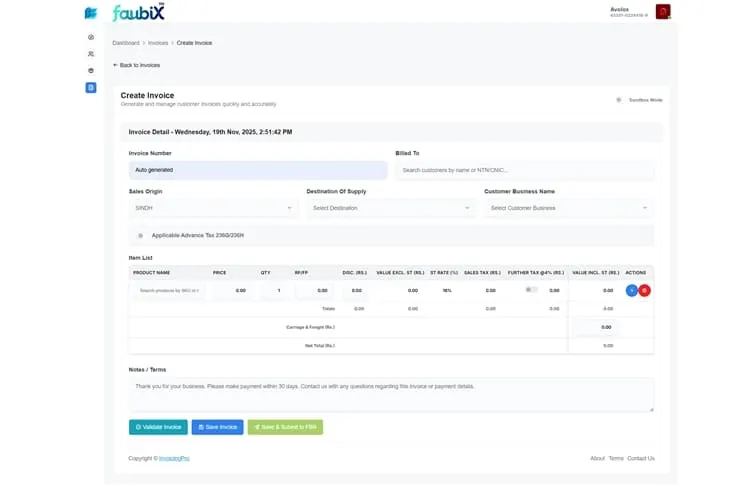
Sindh restaurants and salons caught by the Schedule must route every sale through an SRB-integrated POS — and the rate on the bill changes with how the customer pays. eInvoicePro handles that, and the federal obligation, from one workflow.
Who it's for
Only the two Schedule entries are caught — restaurants and beauty and physical well-being services — and each by its own category tests.
In a hotel or air-conditioned mall, a franchiser or franchisee, more than one branch in Sindh, or turnover above Rs 5 million.

Beauty parlours, salons, beauty and slimming clinics, gyms and physical fitness centres — the second Schedule entry.

A second branch in Sindh brings you in regardless of turnover, and every point of sale has to report, internet orders included.
Why two systems hurt
Section 73A, inserted by the Sindh Finance Act 2026, lets SRB disclose taxpayer particulars to other authorised federal and provincial authorities — which makes a gap between your two sets of records easier to surface than it used to be.
The rate
Sindh ties the rate to the payment method on each individual bill, which makes the payment step and the invoicing step inseparable at the counter.
No input tax credit is admissible at the reduced 8% rate, which is why some restaurants apply to SRB for a special dispensation to charge 15% on digital payments and keep their adjustments. Serial 2B was substituted by the Sindh Finance Act 2024 and adds sealing on repetition and possible imprisonment on conviction; the older Serial 7B was omitted by the same Act. Confirm your position with a qualified tax adviser rather than relying on these figures alone.
Getting compliant
Scope first, because for a single-site restaurant under the threshold the answer may be that no integration is required at all.
Hotel or mall location, franchise status, branch count, and turnover over the preceding twelve tax periods.
Per-payment 8% and 15% without input credit, or the dispensation and a single rate that keeps adjustments.
Both authorities wired to the same workflow, so the sale is entered once.
Receipts carry the SRB invoice number and QR, and returns route through credit notes.
Capabilities
Built for a service counter under load, where the rate is not known until the customer has chosen how to pay.

The 8% and 15% split applied from how the bill was actually settled, including split payments — not assumed before the card is tapped.
One entry reaches whichever authority the sale is owed to, so the provincial and federal records cannot drift apart.

Counters can stay on familiar screens while the API carries validation and submission behind them.
Book a short call. We will walk through your category and your outlets before you spend anything — and tell you if you are out of scope.
FAQ
Scope, the rate split, and how SRB sits next to the federal obligation.
It is the software that connects your till to the Sindh Revenue Board’s Sales Data Controller, so each taxable sale is reported as it happens and the receipt carries an SRB invoice number and QR code. It is required only of businesses in the Schedule to the 2022 Online Integration Rules — restaurants meeting one of the category tests, and beauty and physical well-being services.
No. A restaurant is caught only if it is located in a hotel, motel or guesthouse; is a franchiser or franchisee; has more than one branch in Sindh; is in an air-conditioned shopping mall; or had turnover above Rs 5 million over the immediately preceding twelve tax periods. A single-branch standalone restaurant below that is outside the mandate. Where it does apply, a Karachi business registered federally can owe FBR digital invoicing too, and eInvoicePro reports to both from the same counter.
The rate follows the payment method on each bill: 8% where the customer pays by debit card, credit card, mobile wallet or QR scan, and 15% where payment is by cash or another channel. Tax therefore cannot be computed before payment is settled, and split payments have to be resolved rather than guessed. Note that no input tax credit is admissible at 8% — if you hold a special dispensation from SRB to charge 15% across the board and keep your adjustments, the counter runs a single rate instead.
Usually not. Counters can keep their familiar screens while eInvoicePro handles validation and submission behind them, through the product or through the API for POS software houses. Book a demo and we will map your current flow before anything is replaced.
It needs one system that knows which authority each outlet answers to. SRB and PRA have different scope tests, different rates and different penalties, but a business running both provinces from separate tools ends up reconciling them by hand. We will map outlet by outlet on a short call.
Serial 2B of section 43 of the Sindh Sales Tax on Services Act 2011, as substituted by the Sindh Finance Act 2024 with effect from 1 July 2024, provides for a penalty of up to Rs 1,000,000 and not less than Rs 100,000 — Rs 100,000 is the floor, not the ceiling. On repetition the premises are liable to sealing, and on conviction by a Special Judge there is further liability to imprisonment of up to one year, or a fine of up to Rs 100,000, or both. The older Serial 7B, still widely quoted, was omitted by the same Act. How a default is characterised depends on your own facts — take advice.
Continue
The rule itself, the Punjab equivalent, or the counter product behind both.
The rule itself — scope, the rate split, the 2022 Rules and what a compliant receipt carries.
Read moreThe Punjab equivalent, for operators running outlets in both provinces.
Read moreHow the same counter handles FBR digital invoicing at checkout speed.
Read moreFor POS software houses connecting existing counter stacks.
Read moreJoin 2000+ businesses using eInvoicePro for real-time FBR integration and automated tax compliance.